
Reddit is not designed for cross-history questions like where an account has commented or when a product name first appeared. This tutorial uses Arctic Shift to search that public history by user, keyword, and date, then shows how to analyze a small result set with an AI assistant.
What Arctic Shift is#
Arctic Shift is a community-run project that archives public Reddit data and makes it available three ways: monthly data dumps for large-scale analysis, an API for scripted queries, and a web search interface, hosted at arctic-shift.photon-reddit.com, that runs in a browser with no account. When I tested it, the search page was reachable without authentication.
For Reddit comment search and Reddit search by user, the web interface is the easiest starting point, and it is the default path in this tutorial. The API URLs appear in a few technical notes because they make each query reproducible — the web interface produces the same queries under the hood.
Two honest caveats before we start. Arctic Shift is a historical lookup tool, not a live feed: it searches what has been archived, with no guarantee of complete coverage or instant availability. And it is a free service with dynamic rate limits and, in the maintainer's own words, no uptime guarantees. Treat it as a fast research tool, not infrastructure your product depends on.
How to search Reddit comments by user#
The most common task is simple: find everything a specific account has said. As a working example, I will use u/mentiondesk, a public account that markets a product called ParseStream. Studying it is a good stand-in for studying any competitor's public Reddit footprint.
In the Arctic Shift search interface:
- Choose the comments search.
- Enter
mentiondeskin the author field. - Set a modest limit (10 is plenty to start) and sort in descending order so the newest items come first.
- Run the query.
The filled-in author and date filters should look like this:
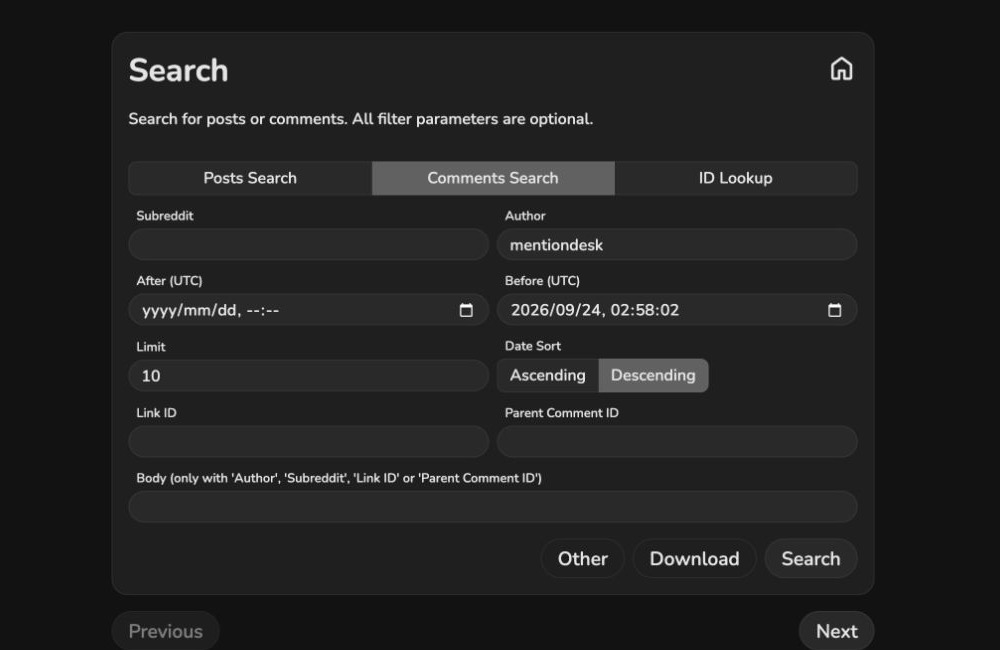
The equivalent API call, if you prefer curl or want to save the query for later:
https://arctic-shift.photon-reddit.com/api/comments/search?author=mentiondesk&limit=10&sort=descWhen I ran this on 2026-09-30, it returned ten recent comments, each in a different subreddit — AppBusiness, AIWorkStack, AI_Agents, chrome_extensions, buildinpublic, careerguidance, gtmengineering, and others.
Each result preserves the subreddit, author, timestamp, comment text, and links back to Reddit and the archived item:
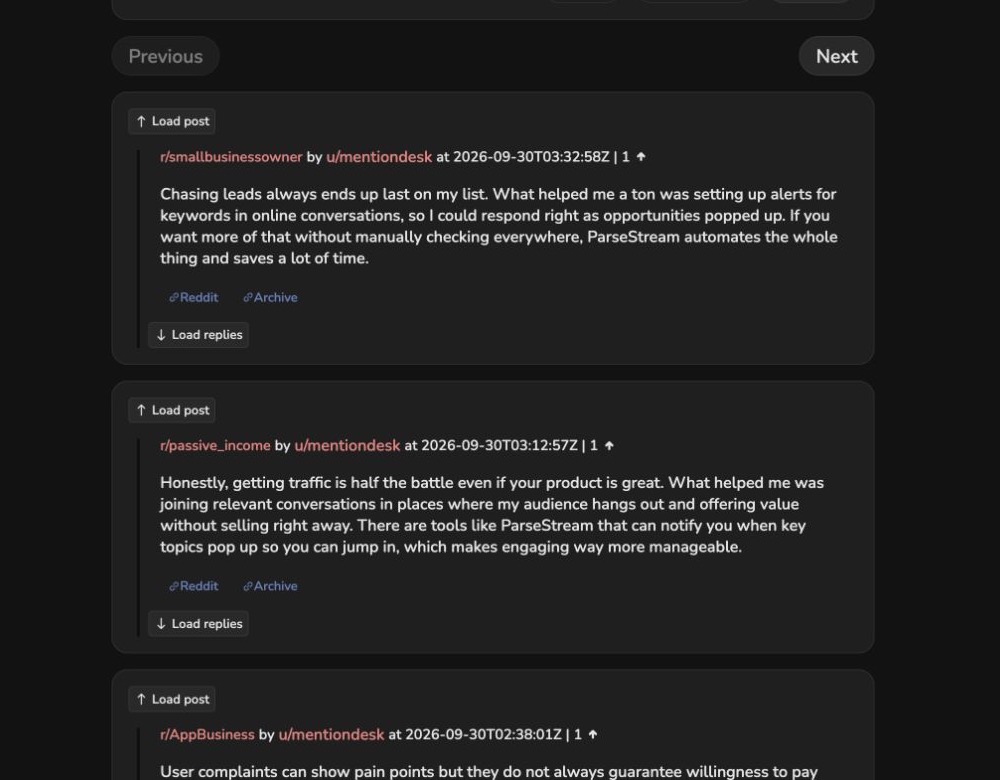
Run the same query against posts as well. Posts and comments reveal different behavior, and comparing them is where the interesting findings start:
- A comment in r/AppBusiness (2026-09-30) answers someone else's question about validating an app idea, then suggests a tool for tracking keyword activity.
- A comment in r/gtmengineering (2026-09-30) replies to a question about intent data sources with general advice, then pivots to the same product.
- A post in r/SideProject (2026-08-20) is a first-person essay about getting customers from forum threads — broadcast content, not a reply.
One pattern was immediately visible from these two queries: the same essay posted to several founder communities within a day or two (the "first 10 customers" post appeared in r/SideProject, r/indiehackers, and r/Entrepreneurs between 2026-08-19 and 2026-08-20), while the comments spread across many small, unrelated niche subreddits. Posts carry the narrative; comments carry the distribution.
Before you conclude anything from a single result, open the original Reddit thread from the link in each result. A comment that looks generic in the search result may be a top-level reply in one thread and a buried fifth-level reply in another, and that difference changes what the mention is worth.
How to map where a Reddit user is active#
Reading ten comments tells you what an account says. The next question is where it operates. Arctic Shift's subreddit-interactions view aggregates an author's activity by community:
https://arctic-shift.photon-reddit.com/api/users/interactions/subreddits?author=mentiondesk&limit=20On 2026-09-30 this returned a ranked footprint dominated by founder and marketing communities:
| Subreddit | Interactions |
|---|---|
| r/SaaS | 709 |
| r/AskMarketing | 446 |
| r/buildinpublic | 379 |
| r/micro_saas | 350 |
| r/Entrepreneurs | 284 |
| r/aeo | 244 |
| r/AppBusiness | 175 |
| r/founder | 126 |
This table answers a real competitive question in one query: this account's highest-frequency activity is concentrated in SaaS builder, indie founder, and marketing/SEO communities. If you were competing for a similar audience, these are communities worth investigating.
Two limits keep this honest. Interaction counts are evidence of frequency, not of performance — they say nothing about conversions, reach, or customer acquisition. And an aggregate like this shows where an account has been active historically, which is not necessarily where it is active this month. Combine it with a date-filtered query before acting on it.
How to search for a competitor keyword#
Next: trace a specific product name. The naive approach — search the phrase ParseStream across all of Reddit — is where most people hit the tool's main limitation. In Arctic Shift, keyword text search is scoped by design: a comment body search requires an author, subreddit, post ID, or parent comment, and a post title or self-text search requires an author or subreddit. The API documentation states this plainly, and in practice unscoped or loosely scoped keyword queries are also the ones most likely to time out.
So scope the keyword to the account you are already studying. In the comments search, put the exact phrase "ParseStream" (with quotes) in the body field and mentiondesk in the author field:
https://arctic-shift.photon-reddit.com/api/comments/search?body=%22ParseStream%22&author=mentiondesk&limit=10&sort=descThis scoped exact-phrase query returned ten matching comments on 2026-09-30. Reading them as a set, the structure repeats:
- Open with a direct, generic answer to the original poster's actual question.
- Follow with a conditional pivot: "If you want to catch real time conversations...", "If you want to spot leads faster...".
- Introduce ParseStream as a way to track keyword activity and find relevant conversations across Reddit and other platforms.
The benefit claim stays remarkably consistent (find and track relevant conversations faster), but the surrounding frame adapts to each subreddit: validating app ideas in r/AppBusiness, distribution for a Chrome extension in r/chrome_extensions, finding UGC clients in r/UGCSideHustle, intent data sources in r/gtmengineering. Same product, same promise, different problem framing per community. That adaptation pattern is exactly the kind of observation a keyword trace is good at surfacing.
One more distinction matters: this is a historical keyword trace. It shows where the phrase has already appeared inside a bounded result set. It does not tell you about new mentions going forward, and it does not prove anything about the effectiveness of these mentions. Catching future conversations as they happen is a monitoring workflow, not a search workflow — more on that distinction later.
How to filter results by date#
Date filters turn a pile of results into a timeline. Arctic Shift's post and comment searches accept after and before, and the values can be plain dates (2026-09-20), full timestamps, or relative offsets like 1year. Results are sorted by each post or comment's created_utc timestamp.
In the web interface, set the after and before dates on the same comments search. The two forms look like this:
https://arctic-shift.photon-reddit.com/search?fun=comments_search&author=mentiondesk&before=2026-09-24T02%3A58%3A02&limit=10&sort=desc
https://arctic-shift.photon-reddit.com/api/comments/search?author=mentiondesk&after=2026-09-20&before=2026-10-01&limit=10&sort=desc
To see how the pieces combine, picture the two activity bursts this account showed when I ran the queries on 2026-09-30 on a timeline:
mid-August                                 late September
    |                                           |
    posts: founder essays in several           comments: replies across many
    subreddits, same essays reposted           niche subreddits, most carrying
                                               a product mention

    |------ before=2026-08-21 ------|
|--- after=2026-09-20, before=2026-10-01 ---|after=2026-09-20&before=2026-10-01returns only the September comment burst.- Adding
sort=ascreads that burst chronologically;sort=descshows the newest first. - Run the posts search with
before=2026-08-21to isolate the mid-August essays; use the September date window on the comments search to isolate the later comment burst.
Date windows answer questions a flat list cannot: when did a phrase first appear in an account's history, did the posting pattern change between two months, and was activity continuous or bursty? For the example account, the two-query picture — essay posts in mid-August, widespread comments by the end of September — is already a more useful competitive observation than any single result.
How to analyze the results with an AI assistant#
Arctic Shift retrieves; it does not interpret, and it has no built-in AI. The interpretation step happens in the AI assistant of your choice, and its quality depends almost entirely on how you prepare the evidence. The method that works has five steps:
- State one research question. "How does this account position ParseStream across subreddits?" is answerable. "Analyze this Reddit account" is not.
- Collect a bounded source set. Keep the query URL, each item's Reddit link or ID, its subreddit, its date, and a short relevant excerpt.
- Separate evidence from interpretation. Store what the item says and what you think it means in different places.
- Ask for structured synthesis. Require themes, supporting source IDs, contradictions, unknowns, and confidence levels.
- Review the original context. Open the linked thread for every observation you actually use. Summaries drift; sources do not.
Steps 2 and 3 are easiest with a source table. Copy this template before your next AI-assisted pass:
| ID  | Original URL  | Author      | Subreddit        | Date       | Type    | Relevant excerpt                                  | Research note                                       |
| --- | ------------- | ----------- | ---------------- | ---------- | ------- | ------------------------------------------------- | --------------------------------------------------- |
| S1  | (reddit link) | mentiondesk | r/AppBusiness    | 2026-09-30 | comment | "If you want to catch real time conversations..." | Product mention is a closing pivot, not the topic   |
| S2  | (reddit link) | mentiondesk | r/gtmengineering | 2026-09-30 | comment | "Scraping replies to competitor threads..."       | Product framing shifts toward intent-data use cases |
Here is what a populated version looks like when the evidence and interpretation columns stay visibly separate:
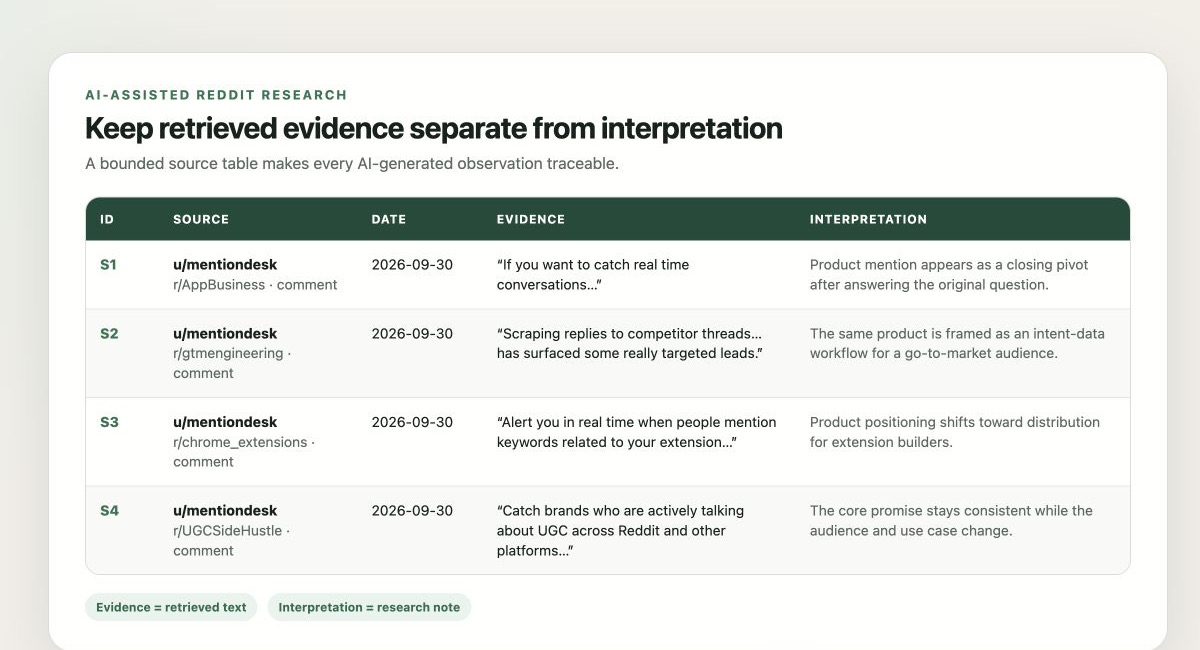
The excerpt column holds retrieved evidence, verbatim and short. The research note column holds your interpretation. Keeping them separate is what lets you (and your AI assistant) tell later what was actually said versus what was inferred.
With the table filled in, use a prompt that forces the assistant to stay inside the evidence. Here are two that match the workflows above.
Competitor marketing footprint — for the "where and how does this account market" question:
You are analyzing a bounded set of public Reddit posts and comments from one
account. Group the items by subreddit, target audience, problem framing,
product mention, benefit claim, and call to action. For every observation,
cite the supplied source ID and date. Separate direct evidence from inference,
and label which is which. Do not infer conversions, intent, or campaign
performance from posting frequency. Finish with contradictions between sources
and questions the data cannot answer.
Competitor keyword trace — for the scoped "ParseStream" result set:
Analyze only the supplied Reddit items that contain the exact phrase
"ParseStream". Build a table with columns: source ID, original link, date,
subreddit, surrounding discussion, product positioning, promised benefit, and
whether the mention is central or incidental to the item. Then list messaging
patterns that repeat across sources and meaningful exceptions. Mark each
conclusion as direct evidence or inference, and do not add facts that are
absent from the supplied sources.
The shared DNA is deliberate: source IDs and dates on every claim, evidence and inference kept apart, unknowns made explicit. Vague prompts produce vague summaries; these constraints are what make the output checkable against the sources.
Historical search versus ongoing monitoring#
Arctic Shift is useful when you know what historical question you want to ask. The moment your job changes from looking backward to catching new competitor or keyword conversations as they appear, you need a different workflow — continuous monitoring — because historical search does not alert you to anything.
| Reader job | Best next step |
|---|---|
| Investigate an account's existing history | Arctic Shift author search |
| Trace an existing product phrase in a bounded set | Arctic Shift scoped keyword search |
| Summarize selected historical examples | Arctic Shift plus an AI assistant |
| Receive new competitor or keyword conversations | Ongoing keyword or competitor monitoring |
| Prioritize potentially relevant new discussions | IntentLoom scoring and human review |
This is where IntentLoom fits, and where it stops overlapping with Arctic Shift. IntentLoom does not provide Arctic Shift's search interface, its author-history search, or its historical archive — for one-off historical lookups, Arctic Shift is the right tool and this tutorial stands on its own. IntentLoom is for what happens after: monitoring keywords and competitor names continuously, scoring the new conversations it finds, drafting replies you can edit, and keeping a human decision on everything that goes out.
Troubleshooting and practical limitations#
A few rough edges come up regularly. None of them are reasons to avoid the tool; they just shape how you should query it.
- Keyword queries time out. Timeouts cluster around body and title searches, especially unquoted phrases or broad scopes. Use an exact phrase in quotes, add an author or subreddit scope, drop the limit to 10, and retry once — the service notes that its database needs to warm up for some queries. If it still fails, narrow further before you widen.
- Text search demands a scope. Comment body search requires an author, subreddit, post ID, or parent comment; post text search requires an author or subreddit. This is a design constraint, not a bug, and it is why the keyword section of this tutorial scopes
ParseStreamto one account. - Coverage is historical, not guaranteed real-time. Arctic Shift searches an archive of public Reddit data. Very recent items may not be there yet, and no tool of this kind guarantees that every post and comment is captured. Verify anything time-sensitive on Reddit itself.
- Rate limits are dynamic. Heavy scripted use will get throttled. For bulk research, the project offers monthly dumps instead of hammering the API.
- AI summaries need original context. Open the linked Reddit thread for every observation you rely on. A summary that cannot be checked against its source is a hypothesis, not a finding.
FAQ#
How do I search Reddit comments by user?
Open Arctic Shift's comments search, enter the username (without u/) in the author field, set a small limit, and sort descending. The result set lists the account's comments with dates, subreddits, and links to the original threads.
Can Arctic Shift search Reddit comments by keyword?
Yes, with a scope. Comment body search requires an author, subreddit, post ID, or parent comment, so searches like "ParseStream" within one account's history work well while unscoped site-wide phrase searches do not. Exact phrases in quotes are the most reliable form.
How do I search Reddit comments before or after a date?
Use the after and before fields on any search. Both accept plain dates (2026-09-20), full timestamps, and relative offsets like 1year. Combine them to define a window, and use ascending sort to read the results chronologically.
Is Arctic Shift free? Yes. It is a free, community-run service offering a web search interface, an API, and monthly data dumps, with dynamic rate limits and no uptime guarantees. Heavy users are pointed toward the dumps.
Can I use ChatGPT, Claude, or another AI assistant to analyze the results? Yes — the AI step is external to Arctic Shift and works with any assistant. The preparation matters more than the model: give it a bounded source table with IDs, dates, and links, and require it to cite sources and separate evidence from inference.
Why did an Arctic Shift keyword query time out? Most often because the query was too broad — an unquoted phrase, a very active author or subreddit, or a large limit. Quote the phrase, keep an author or subreddit scope, reduce the limit, and retry. Persistent timeouts mean the scope is still too wide.
What is the difference between historical Reddit search and Reddit monitoring? Historical search (Arctic Shift) answers questions about what has already been posted, on demand. Monitoring runs continuously, surfaces new keyword or competitor conversations as they appear, and supports scoring and alerts. Research starts with the first; staying current requires the second.
Conclusion#
Arctic Shift works best for focused historical research: start with a specific question, keep the result set small, and preserve the original links so every AI-assisted finding can be checked. Use monitoring when the job shifts from investigating past conversations to catching new ones — and keep a person in charge of the final judgment.