Reddit marketing guide
How To Monitor Reddit for Keywords Without Drowning in Noise
If you want to monitor Reddit for keywords, the goal is not to catch every mention of a word and drown in alerts. The goal is to notice the conversations that are actually relevant to your product early enough to do something useful with them. For most SaaS founders, that means tracking a focused set of product, problem, and competitor keywords, then reviewing matched posts for relevance before deciding what deserves attention in the broader Keyword Match → AI Score → Reply Draft → Human Review workflow.
Written by Michael Yin
 Written by Michael Yin
What is Reddit keyword monitoring actually for?
Reddit keyword monitoring is not social listening in the broad sense. Its job is narrower and more practical: catch product-relevant discussions early, watch demand signals and recurring pains, track competitor mentions and comparison language, and replace manual browsing with a repeatable discovery workflow. Some matched threads also have search visibility, which is why it helps to find Reddit threads ranking on Google before you decide where to focus.
| Keyword type | What it helps you detect | When to use it |
|---|---|---|
| Product keywords | Direct mentions of your product or category name. | From day one, to catch conversations already about you. |
| Problem keywords | Pain-point language and recurring frustrations your product solves. | When you want to find people describing the problem before naming a solution. |
| Competitor keywords | Mentions of competing products and comparison language. | When buyers are evaluating alternatives, including yours. |
| Switching language | Phrases like "alternative to", "vs", "replace", or "moving from". | To catch evaluation moments where someone may be open to switching. |
| Recommendation requests | Questions like "best tool for", "what do you use", or "can anyone recommend". | When someone is actively asking the community to help them choose a solution. |
Why manual Reddit monitoring breaks down fast
Manual checking works for a little while, then stops scaling. The problem is not effort alone; it is that most of what you scan is noise, and timing works against you.
- Too many posts and mentions to review by hand every day.
- Too many new posts per day to read them all carefully.
- Timing matters — good threads go stale quickly, so checking weekly means missing the window.
- Repeated manual checking burns founder time that should go to building and replying.
Reddit search, keyword alerts, and monitoring compared
Manual Reddit search works for occasional research. Raw keyword alerts make discovery repeatable, but a literal match still does not tell you whether the conversation matters. Intent-filtered monitoring adds prioritization while keeping the final judgment with you.
Once a new lead meets your relevance threshold, IntentLoom can route it to Email, a connected Slack public channel, or a Generic Webhook. That keeps timely opportunities visible without turning every keyword match into an interruption, and you still review the thread before deciding whether to reply.
| Dimension | Manual Reddit search | Raw keyword alerts | Intent-filtered monitoring |
|---|---|---|---|
| Discovery | Repeat searches and check relevant communities yourself. | Collect literal keyword matches for later review. | Bring keyword matches into a repeatable review workflow. |
| Noise | Depends on the query and your manual judgment. | Often includes casual, ambiguous, or off-topic mentions. | Uses relevance and intent scoring to prioritize what to inspect first. |
| Prioritization | Decide the value of every result yourself. | Usually starts and ends with the keyword match. | Review higher-signal matches before lower-priority ones. |
| Best fit | Occasional research or a very small keyword set. | Broad awareness when nearly every mention may matter. | Finding product-relevant conversations without treating every mention as a lead. |
A better workflow: monitor, then filter for signal
Before choosing terms, build a focused subreddit map so the community scope is intentional. Then track a focused keyword set and read the relevance and intent score of matched posts instead of acting on every mention. Monitoring comes first; filtering for signal is what makes the matches usable inside Keyword Match → AI Score → Reply Draft → Human Review.
- 1
Start with product keywords
Begin with your product and category name. This is the smallest set that catches conversations already relevant to you before you widen the net.
- 2
Add problem-language keywords
Add the pain-point and problem terms your buyers use to describe their situation before they know your product exists. This widens the net without adding random noise.
- 3
Add evaluation and recommendation language
Add competitor names, switching language such as "alternative to", and recommendation phrases such as "best tool for". These terms catch evaluation moments when someone is comparing options or asking for help choosing one.
- 4
Review matched posts for relevance and score
Before acting on any match, look at the relevance and intent score of the matched posts rather than treating every mention as equal. Most matches will be casual discussion; reading the score is what separates useful signal from noise.
- 5
Refine the keyword set
Keep, drop, or add keywords based on which ones keep producing useful matches. The list gets sharper over time, so the same workflow gets less noisy the longer you run it.
Framework
Product keywords → Problem keywords → Evaluation and recommendation language → Review matches
A real 30-day IntentLoom snapshot
Broad searches filled most of the review list
Over 30 days, the two broad searches “find clients” and “find customers” made up 84% of the conversations linked to a search term. Broad searches are useful for discovery, but they need a second step before someone reaches out.
- linked to a search term
- 1,638
- out of 1,705 saved conversations
- had a saved keyword
- 96.1%
- 67 could not be tied back to one keyword
- came from two broad searches
- 83.6%
- “find clients” and “find customers”
When we looked
Last 30 days: July 24–August 24, 2026
What was included
1,705 saved conversations; 1,638 were linked to a search term.
What you can take from this
Start broad to find conversations, then review context before deciding whether to research or reply.
A quick note on the data
- This is a real 30-day snapshot from one IntentLoom project, not an industry benchmark.
- It includes conversations our system kept after its first screen, not every Reddit post or keyword alert.
- The labels help sort conversations. They do not confirm that someone will buy or measure results.
What keywords should you track first?
Keep your first list small and deliberate. You can always refine it as you learn which terms produce useful conversations. A short, focused set is easier to review and far less noisy than a long generic list. For example, imagine a SaaS product that helps support teams identify recurring customer problems.
| Keyword type | Example |
|---|---|
| Product or category | "support analytics", "customer feedback analysis" |
| Problem language | "too many support tickets", "cannot find recurring complaints" |
| Competitor names | Names of the tools your target buyer evaluates or already uses |
| Switching language | "alternative to [tool]", "replace [tool]" |
| Recommendation requests | "best tool for analyzing support tickets", "what do you use to find recurring customer complaints" |
Worked example: from match to a reviewed reply
Suppose a founder posts, “What do you use to find recurring complaints across a growing support queue?” That question is a useful candidate for review, but the keyword match alone does not make it a lead.
- Keyword Match: A post contains a monitored problem phrase or recommendation request.
- AI Score: Relevance and intent signals help you judge whether the match deserves attention instead of assuming it is qualified.
- Human Review: You read the original thread and community context before deciding whether a reply would be useful.
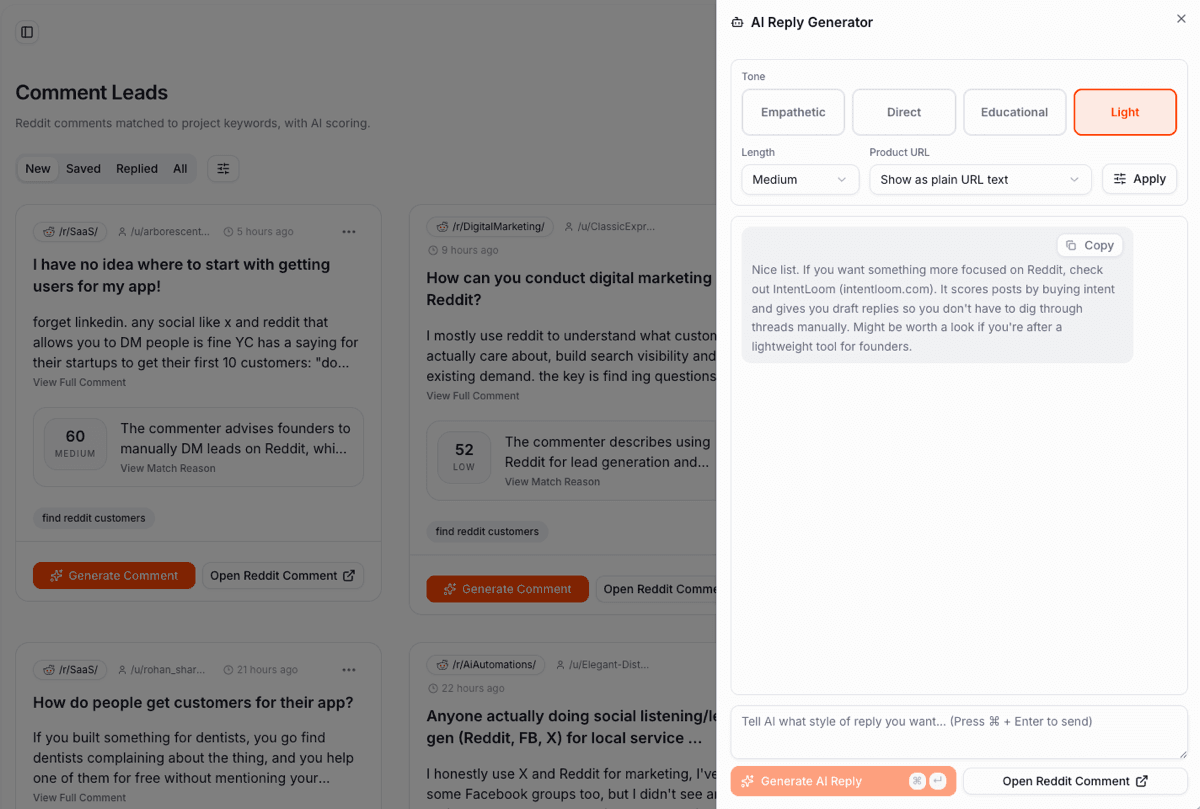
- Draft Reply: IntentLoom can prepare a draft for you to edit or use; nothing is posted automatically.
How IntentLoom helps you monitor Reddit with more signal
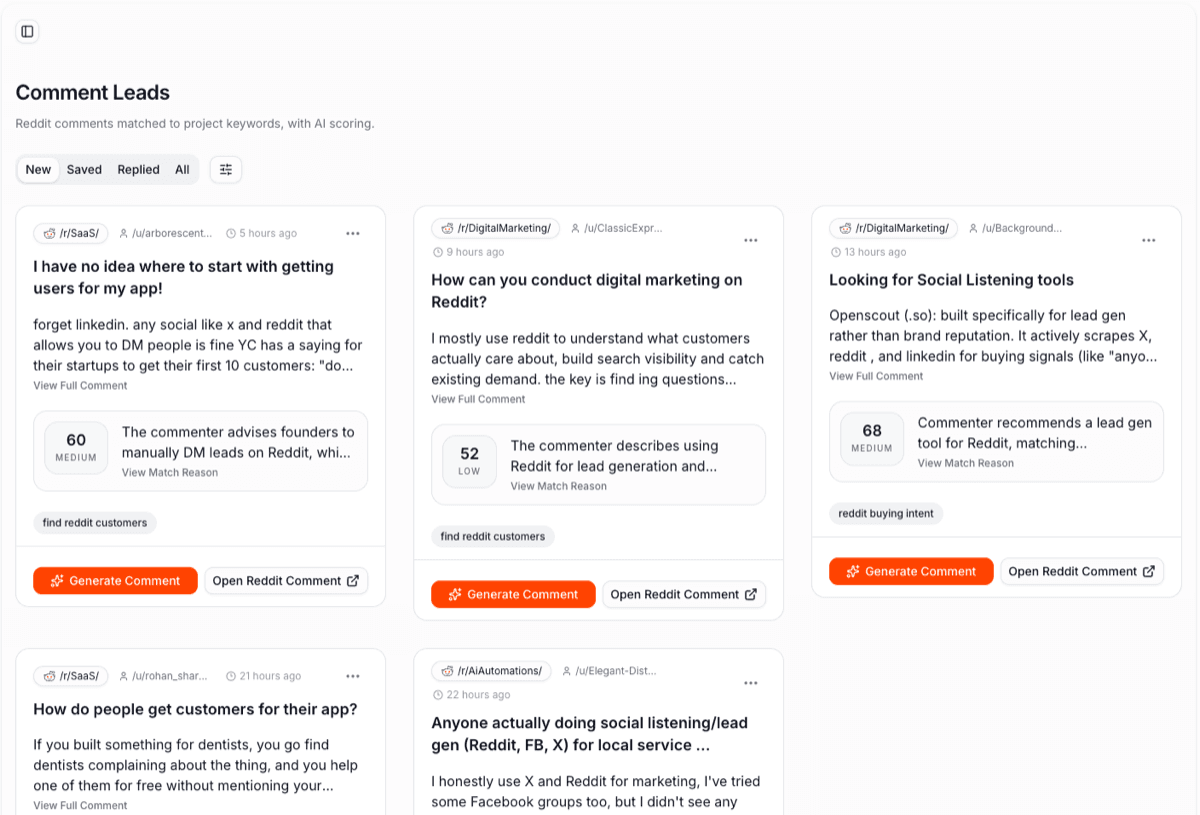
IntentLoom is built around the monitor-and-review workflow above. It does not auto-post to Reddit and it does not turn monitoring into autopilot lead generation. It handles the part that is hardest to do by hand: tracking the right keywords and surfacing relevant matches without forcing you to live inside a noisy alert feed, so the next steps in AI scoring and draft-reply review stay focused.
- Track product, problem, competitor, switching, and recommendation-request keywords across the subreddits you choose.
- Surface relevant matches through AI relevance scoring instead of raw mention volume.
- Help a solo founder move from monitoring to prioritization and a review-based reply workflow.
- Route newly qualified leads to Email, Slack, or a Generic Webhook while keeping review and publishing decisions with you.
- Keep human review in the loop, so nothing posts without your approval.
Monitoring is step one. Qualification is step two.
Monitoring gets you early visibility into relevant conversations. Qualification is what turns those matches into real opportunities: not every keyword hit is a lead, and the next step is deciding which matched threads show active evaluation or buying intent. If you want to go one step further, learn how to qualify the threads your monitoring surfaces, or apply the same workflow specifically to competitor mentions.
Common mistakes in Reddit keyword monitoring
- Tracking too many keywords too early, which floods your feed with off-topic matches.
- Treating noisy matches as useful opportunities instead of reading the relevance and score.
- Treating every keyword mention as a lead instead of qualifying it.
- Ignoring competitor terms, which misses evaluation and comparison moments.
- Never refining the keyword list, so noise never goes down over time.
Frequently asked questions
What is the best way to monitor Reddit for keywords?
Track a focused set of product, problem, and competitor keywords, then read the relevance and intent score of matched posts before acting. The goal is early visibility into relevant conversations, not collecting every mention, so a tight keyword list and a signal filter matter more than raw alert volume.
Are Reddit keyword alerts enough?
Keyword alerts catch mentions, but most mentions are not relevant or commercial. Without a relevance and noise filter, alerts surface off-topic chatter and casual discussion alongside the few posts that matter. Alerts are a useful input, but they are not a complete monitoring workflow on their own.
What keywords should I track on Reddit?
Start with product and category names, then add problem-language terms, competitor names, switching language such as "alternative to", and recommendation requests such as "best tool for" or "what do you use for". Keep the list small at first and refine it as you learn which terms produce useful conversations.
How do I reduce noise in Reddit keyword monitoring?
Use a smaller, more deliberate keyword list and read the relevance and intent score of matched posts before acting on them, rather than treating every mention as equal. Filtering noisy matches out is what turns a loud alert feed into a manageable monitoring workflow.
How does keyword monitoring connect to finding leads?
Monitoring is the first step: it surfaces relevant conversations early. Qualifying those conversations for buying intent is the second step, where you decide whether a matched post is worth joining. Monitoring alone does not produce leads; it produces the raw material that a qualification step turns into opportunities.
What is the difference between Reddit keyword search and keyword monitoring?
Reddit keyword search is a manual, point-in-time check, while keyword monitoring turns a focused set of searches into a repeatable discovery workflow. Search works well for occasional research; monitoring is more useful when you need to review new matches consistently and refine the keyword set over time.
Can a Reddit keyword tracker reduce irrelevant alerts?
A keyword tracker reduces irrelevant alerts only when it does more than collect literal matches. A focused keyword set plus relevance and intent scoring can help you prioritize useful conversations, but you still need to review the original post and context before deciding whether to act.
Related guides
Plan Reddit marketing around community research, useful participation, transparent product mentions, and human review.
Compare Reddit tools by job: research, monitoring, lead review, replies, analytics, and ads.
The end-to-end SaaS acquisition loop: monitor, prioritize, review replies.
Qualify matched threads for real buying intent before you reply.
Track competitor conversations where comparison and switching start.
Discover Reddit threads with Google visibility and prioritize the ones worth a reply.
Find relevant Reddit conversations without treating every match as a lead.
Send qualified Reddit opportunities to Email, Slack, or a Generic Webhook.
See the right conversations early enough to act on them.
Good Reddit monitoring is not about seeing more posts. It is about noticing the right conversations early enough to do something useful with them.